DEXA Scan vs. Bod Pod: Same Accuracy, Very Different Data
The Bod Pod is one of the more honest body composition tests available. It uses air displacement physics - not electrical guesswork - to measure your body volume and calculate fat versus fat-free mass. Its margin of error sits around 2-3%, which is close to DEXA's 1-2% and meaningfully better than BIA-based methods like InBody or smart scales. So if accuracy is the only measure, the Bod Pod and DEXA are closer than most comparisons suggest. The real difference is what you walk away with. The Bod Pod gives you one number: total body fat percentage. It can't tell you where that fat is stored. It can't measure visceral fat - the fat around your organs that's most predictive of metabolic disease. It can't assess your bone density. And it can't show you the muscle imbalance between your left leg and your right. DEXA does all of that in the same time frame, at a comparable or lower price. This page breaks down how the two methods compare, where each one holds up under scrutiny, and when the difference between them matters.
How the Bod Pod Works
The Bod Pod uses air displacement plethysmography. You sit inside an egg-shaped chamber, and the machine measures your body volume by tracking changes in air pressure. Using your body volume and weight, it calculates body density - and from that density, it estimates your body fat percentage and fat-free mass.
It's a two-compartment model: everything in your body gets classified as either fat mass or fat-free mass. Muscle, bone, water, and organ tissue are all grouped together on one side of that equation. The test doesn't separate them.
A few variables can throw the result off:
Lung residual volume. The Bod Pod accounts for the air in your lungs, but the measurement requires a separate breathing test. If that measurement is off, your body volume calculation is off.
Clothing and body hair. Both trap air and affect the reading. The test requires form-fitting clothing and can produce different results in individuals with significant body hair.
One-size-fits-all equations. Bod Pod results are based on calculations that assume standard bone density. If yours is significantly higher or lower than average, the fat estimate shifts.
The Nomad Fit Lab Difference
A DEXA scanner addresses all of these limitations. It measures bone directly, so it's not affected by bone density assumptions. It's unaffected by clothing or body hair. And it doesn't require a separate breathing test - the scan runs in about 7 minutes, and the results are yours the same day.
How DEXA Measures Body Composition
A DEXA scanner emits two low-dose X-ray beams at different energy levels. Because bone, muscle, and fat absorb X-rays at different rates, the scanner identifies each tissue type directly - not by inference from density. What you get is a three-compartment model: fat mass, lean soft tissue, and bone mineral content, separated at the pixel level across your entire body.
- Total body fat percentage
- Lean muscle mass broken down by region: left arm, right arm, trunk, left leg, right leg
- Visceral adipose tissue (VAT) - the fat around your organs - measured directly
- Bone mineral density and T-scores for osteoporosis screening
- Left-to-right muscle symmetry
The scan takes under 15 minutes.
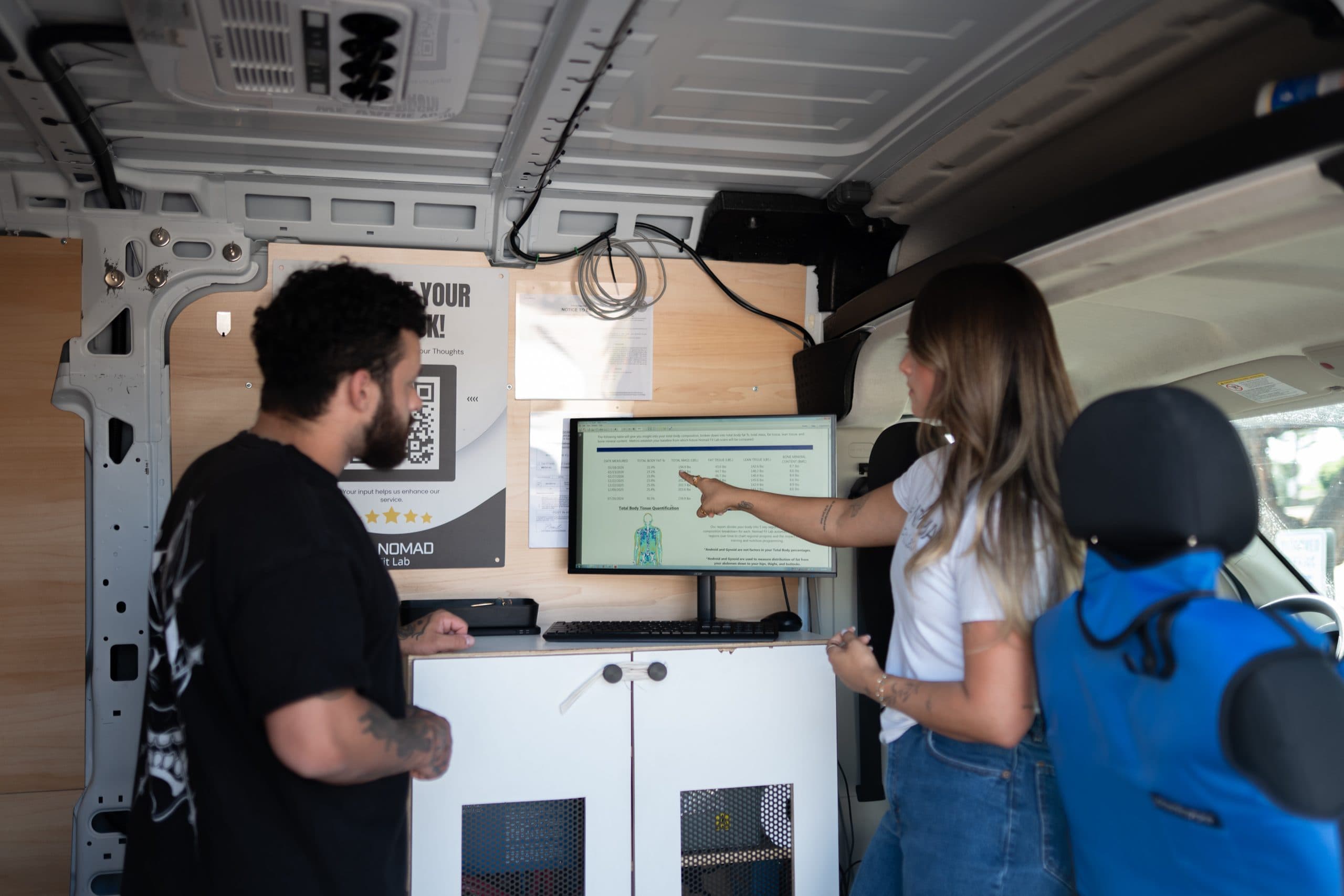
Nomad Fit Lab brings the equipment to your gym or neighborhood across Western Washington and Greater Phoenix - walk-ins welcome, no hospital visit, results in your inbox the same day, from $39.95.
DEXA vs. Bod Pod: Side-by-Side
| Feature | DEXA Scan | Bod Pod |
|---|---|---|
| Method | Dual-energy X-ray | Air displacement plethysmography |
| Fat Mass Error | ~1-2% | ~2-3% |
| Model | 3-compartment (fat, lean, bone) | 2-compartment (fat vs. fat-free) |
| Visceral fat | Measured directly | Not available |
| Bone density | Yes - clinical T-scores | Estimated only |
| Regional breakdown | Full-body map | None |
| Muscle symmetry | Yes | No |
| Affected by clothing/hair | No | Yes |
| Affected by lung volume | No | Yes - requires breathing test |
| Cost per session | From $39.95 | $45-$75/session |
When the Difference Between DEXA and Bod Pod Actually Matters
Athletes tracking performance
Total fat-free mass doesn't tell you whether your left quad matches your right, whether you've added mass in your legs or your trunk, or whether your muscle gain is coming at the expense of bone density. DEXA answers all three.
Anyone over 50 or with bone health concerns
The Bod Pod's bone density output is an artifact of its density equation, not a direct measurement. It is not a substitute for clinical bone density screening. If bone health is part of why you're testing, DEXA is the only appropriate choice.
GLP-1 users
People on Ozempic, Wegovy, or Mounjaro lose both fat and lean mass during rapid weight loss. The Bod Pod will show you total fat-free mass decreasing - but it won't tell you how much of that loss is muscle versus bone versus water. DEXA breaks it down precisely.
Visceral fat screening
High visceral fat is an independent risk factor for cardiovascular disease, type 2 diabetes, and metabolic syndrome - even at a normal total body weight. The Bod Pod can't measure it. DEXA can.
Everything You Need to Know
Is the Bod Pod as accurate as DEXA?
Close, but not equivalent. The Bod Pod has a margin of error of approximately 2-3% for total body fat percentage, compared to DEXA's 1-2%. More importantly, the Bod Pod uses a two-compartment model that groups all fat-free tissue together - muscle, bone, water, and organs - and its accuracy can be affected by lung residual volume, clothing, and body hair. DEXA directly measures fat, lean tissue, and bone separately at the pixel level, with no dependence on those variables.
Can the Bod Pod measure visceral fat?
No. The Bod Pod measures total body fat percentage only. It cannot distinguish between visceral fat - the metabolically active fat around your organs - and subcutaneous fat stored beneath the skin. DEXA measures visceral adipose tissue directly and reports it as a separate metric.
Does the Bod Pod measure bone density?
Not directly. The Bod Pod estimates bone contribution as part of its two-compartment density equation, but it does not measure bone mineral density or produce clinical T-scores. DEXA is the clinical standard for bone density assessment and is the appropriate test for anyone evaluating osteoporosis risk.
How does the Bod Pod compare to DEXA for athletes?
Athletes with higher-than-average bone density can see skewed Bod Pod results because the test's underlying equations assume average bone composition. DEXA measures bone directly, so it's not affected by this. DEXA also provides regional muscle data and left-to-right symmetry analysis that's directly relevant to athletic training and injury recovery - data the Bod Pod doesn't produce.
Is DEXA worth it over the Bod Pod if they're both accurate?
If all you need is a total body fat percentage, the Bod Pod is a reasonable choice. If you need visceral fat data, bone density, regional muscle breakdown, or muscle symmetry - or if you want a test that isn't affected by clothing, body hair, or lung measurements - DEXA provides significantly more information at a comparable or lower cost, depending on where you test.
How much does a Bod Pod test cost?
Bod Pod sessions typically run $45-$75 per test at clinics and university wellness centers. Nomad Fit Lab DEXA scans start at $39.95 and come to your gym or neighborhood - no clinic visit required.
More Data, Same Time Frame
Nomad Fit Lab is a mobile DEXA scan lab serving Western Washington and Greater Phoenix. We bring gold-standard body composition scans directly to your gym or neighborhood. The scan measures bone density, lean muscle mass by region, body fat percentage, visceral fat, and resting metabolic rate. From $39.95, under 15 minutes, with results in your inbox the same day.