DEXA Scan vs. InBody: Which Body Composition Test Is More Accurate?
InBody machines are everywhere - gyms, clinics, wellness studios. They're fast, non-invasive, and produce a detailed-looking printout that feels authoritative. But bioelectrical impedance analysis (BIA) has a core limitation no hardware upgrade has solved: it estimates body composition by measuring how quickly an electrical current travels through your body - and that speed changes every time your hydration changes. A DEXA scan doesn't estimate. It uses two low-dose X-ray beams to directly measure bone, lean muscle, and fat - separately, by region, regardless of when you last drank water or ate. Margin of error: ~1-2%. InBody's: 3-8%.
How InBody Works
InBody devices use direct segmental multi-frequency bioelectrical impedance analysis. The machine sends a small electrical current through your body via foot electrodes and hand grips. Fat resists the current; water and lean tissue conduct it. Based on that resistance reading, the device calculates estimates for body fat percentage, skeletal muscle mass, and total body water.
InBody's approach is more sophisticated than a basic bathroom scale - it uses multiple frequencies and measures each body segment separately. The InBody 570 also measures intracellular and extracellular water, adding clinical value in certain contexts.
But the fundamental limitation remains: InBody is measuring water distribution and working backward to estimate fat.
What skews InBody results?
- Drinking water before the scan lowers apparent body fat
- Dehydration raises it
- Exercise in the hours before redistributes fluid and skews the reading
- Meal timing matters
- Menstrual cycle phase affects results in women
- Age and sex introduce additional bias - InBody tends to underestimate body fat in adults while overestimating in children
That's not a flaw in a specific model. It's a limitation of the physics behind BIA.
How DEXA Works
A DEXA scanner emits two low-dose X-ray beams at different energy levels. Because bone, muscle, and fat absorb X-rays at different rates, the scanner separates them precisely - not estimates them. It provides:
- Total body fat percentage
- Lean muscle mass broken down by region: arms, legs, trunk
- Visceral fat - the metabolically active fat around your organs - measured directly
- Bone mineral density, including T-scores for osteoporosis screening
- Left-to-right muscle symmetry, relevant for athletes and injury recovery
A Nomad Fit Lab DEXA scan takes under 15 minutes
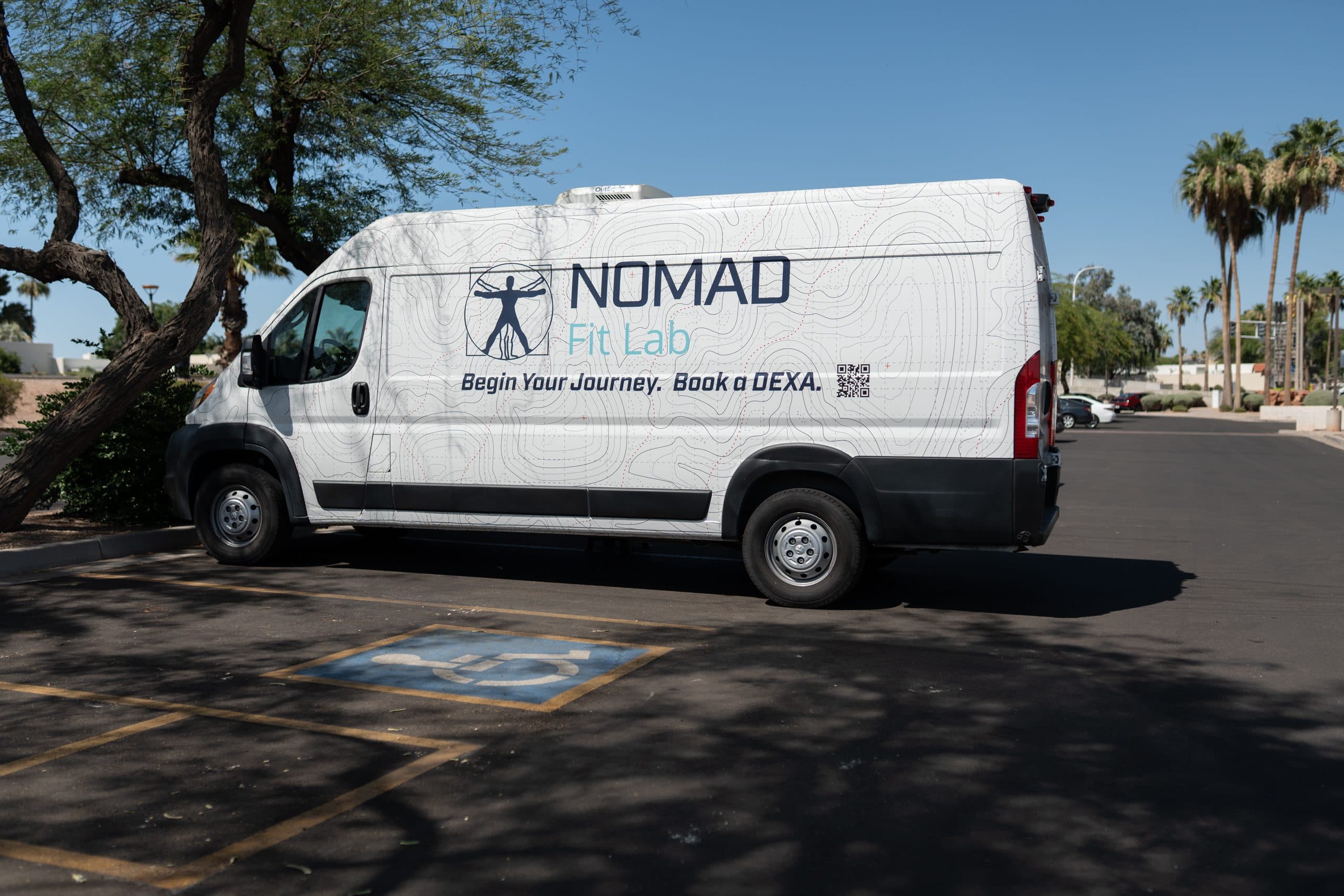
Nomad Fit Lab brings the equipment to your gym or neighborhood across Western Washington and Greater Phoenix - walk-ins welcome, no hospital visit, results in your inbox the same day. From $39.95.
Accuracy Gap: DEXA vs InBody
The accuracy gap between DEXA and InBody is well documented in peer-reviewed literature.
Margin of Error
DEXA: ±1-2% / InBody: ±3-8% (some sources cite higher depending on conditions)
Systematic Bias
A controlled lab study of military adults found InBody produced a −4.0 ± 2.8% body-fat bias compared to DEXA - consistently underreporting body fat.
Sex & Age Differences
InBody accuracy varies by sex and age group, with older adults and women showing the largest discrepancies.
A 4-point underestimation matters.
If InBody tells you you're at 18% body fat and your actual number is 22%, you might stop pursuing a fitness goal prematurely, misjudge the effectiveness of a diet, or miss a clinical threshold that warrants intervention.
DEXA vs. InBody: Side-by-side
| Feature | DEXA Scan | InBody 570/770 |
|---|---|---|
| Fat Mass Error | ~1-2% | 3-8% (real-world bias often higher) |
| Affected by hydration | No | Yes - significantly |
| Visceral fat | Measured directly | Estimated |
| Bone density | Yes | No |
| Regional breakdown | Full-body map | 5 segments |
| Consistent across conditions | Yes | No |
| Systematic bias in adults | None documented | Underestimates body fat by ~3-4% on average |
| Cost per session | From $39.95 | $25-$50/session |
InBody isn't worthless - it's just a different tool for a different job. For trend tracking inside a controlled environment - same machine, same time of day, same hydration and meal conditions every time - InBody can show directional change over weeks and months. Many gyms and clinics use it effectively as a regular check-in tool.
It's also fast, radiation-free, and widely available. If someone needs a quick snapshot and doesn't have access to DEXA, a carefully controlled InBody session is better than relying on a bathroom scale or BMI.
Where it falls short is precision and completeness. InBody cannot measure bone density. Its visceral fat reading is an estimate. And because its absolute numbers carry a systematic bias, it's not the right tool when the number itself matters.
That said, it's not useless. Once you have a DEXA baseline, an InBody can serve as a lightweight check-in. It can be a way to stay consistent and catch directional shifts in your day-to-day training. Think of it as the tool that keeps you accountable between the scans that actually count. When something looks like it's moved meaningfully, that's the signal to get back in the mobile lab and confirm it with another DEXA.
When the difference matters
Starting a body recomposition program
You need an accurate baseline. An InBody reading that underestimates your body fat by a minimum of 4 points means your progress benchmarks are wrong from day one.
Tracking muscle loss on GLP-1 medications
People on Ozempic, Mounjaro, or Wegovy lose both fat and muscle during rapid weight loss. The muscle loss component is exactly what InBody is least reliable at detecting accurately. DEXA gives you a precise split.
Bone health screening
InBody cannot assess bone mineral density. For anyone over 50, post-menopausal, or with osteoporosis risk factors, only DEXA provides a T-score.
Making a clinical decision
If your body composition reading is informing a conversation with a physician, dietitian, or sports medicine provider, the number needs to be trustworthy.
Everything You Need to Know
Is InBody as accurate as DEXA?
No. DEXA has a margin of error of approximately 1-2% for body fat percentage and directly measures fat, muscle, and bone using X-rays. InBody uses bioelectrical impedance to estimate body composition and has a reported margin of error of 3-8%. Real-world studies show InBody also carries a systematic bias, consistently underestimating body fat in adults by an average of 3-4 percentage points compared to DEXA.
What's the difference between DEXA and InBody 570?
The InBody 570 is a mid-tier BIA device that measures segmental body composition across five body segments and includes intracellular and extracellular water data. It does not measure bone density. DEXA provides a full regional body fat map, direct visceral fat measurement, bone mineral density, and left-to-right muscle symmetry data - with significantly higher accuracy and no sensitivity to hydration conditions.
Can InBody measure visceral fat?
InBody provides a visceral fat estimate, but it cannot measure visceral fat directly. The reading is derived from the same BIA resistance measurement and is affected by the same hydration variables. DEXA measures visceral fat directly using X-ray attenuation.
Does hydration affect InBody results?
Yes - significantly. Because InBody measures electrical resistance through body water, anything that changes your hydration changes your result. Drinking water before a scan, exercising in the hours before, eating a large meal, or being in a different phase of your menstrual cycle can all shift your InBody body fat reading by several percentage points. DEXA results are not affected by hydration.
How often should I get a DEXA scan vs. using InBody?
For most people who are not making major changes to diet or activity level, a DEXA scan every 3-6 months gives you reliable absolute data to track meaningful changes in body composition and bone health. InBody can be useful between scans as a directional check - as long as it's done under the same conditions each time and you treat the body fat percentage as approximate, not precise.
Is DEXA safe?
Yes. DEXA uses a very low dose of X-ray radiation - less than a chest X-ray and roughly equivalent to a few hours of natural background radiation. It is not recommended during pregnancy, and we advise not getting a DEXA scan for at least 2 weeks following any medical/diagnostic radiation exposure.
Get Numbers You Can Trust
Nomad Fit Lab is a mobile DEXA scan lab serving Western Washington and Greater Phoenix. We bring gold-standard body composition scans directly to your gym or neighborhood. The scan measures bone density, lean muscle mass by region, body fat percentage, visceral fat, and resting metabolic rate. From $39.95, under 15 minutes, with results in your inbox the same day.